
Webinars past & future.
Regenerate your soil.
Grow your future.
Watch Webinars Past

Woodland Pigs & Charcuterie
As more UK farmers explore regenerative principles and look to stack enterprises that align with their land’s natural potential, woodland pig farming is emerging as an option with surprising depth. Blending ecology, animal husbandry, and premium food production, this model offers both environmental and economic rewards—particularly when grounded in agroforestry.
At Beal’s Farm in East Sussex, Melissa Masters and Phil Beal have taken a bold approach: rearing rare-breed Mangalitsa pigs beneath mature oak canopies, using the trees not just for shelter but as part of a living, working ecosystem.
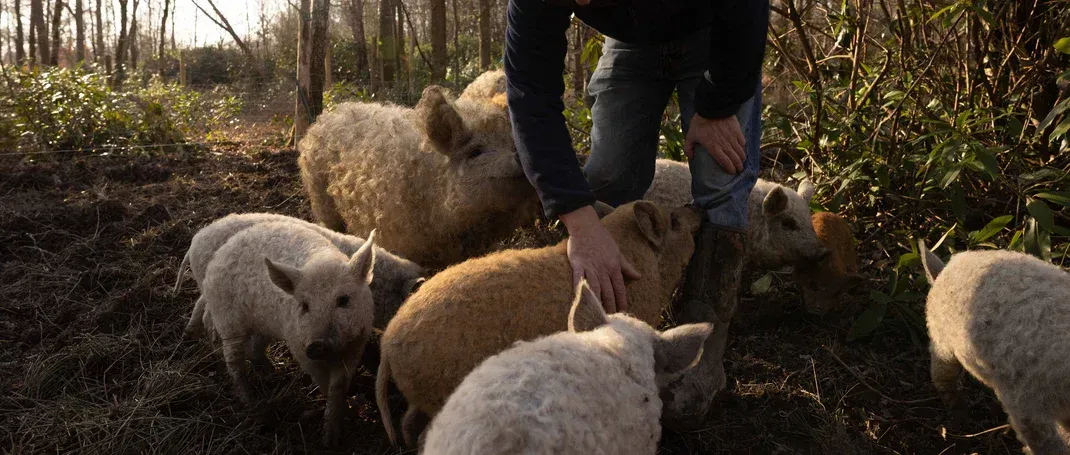
Their work is now the focus of an Innovate UK-funded research project—designed to study how pigs can be integrated into agroforestry systems in ways that regenerate soil, enhance biodiversity, and produce exceptional food.
The Mangalitsa pig, with its distinctive woolly coat and richly marbled meat, is already well known among charcuterie producers. But this isn’t just about niche produce. The team at Beal’s Farm are proving that when managed with care, woodland pigs can serve a wider purpose: maintaining tree cover through natural rooting and coppicing behaviours, fertilising soils in situ, and activating underused woodland into a productive, balanced system.
"The Mangalitsa is the perfect pig for charcuterie. The team at Beal's Farm have taken it to another level"
-- Marcus Wareing - Marcus Restaurant in Knightsbridge
The project, in collaboration with Cranfield University and AgriSound, is taking a scientific lens to this traditional-meets-modern approach. Key areas of study include:
Soil Health – Through 80 samples analysed for microbial life, carbon content, and nutrient balance
Pollinator Biodiversity – Using bioacoustic detection to monitor insect activity
Tree & Habitat Monitoring – Assessing the effects of pig activity on woodland structure and regeneration
Animal Welfare – Behavioural tracking and welfare protocols, comparing traditional vs. woodland-based systems
For those practising or considering Holistic Planned Grazing, this work adds valuable insight into how multi-species and integrated systems can be extended beyond open pasture. It also opens the door to stacked enterprises—using underutilised woodlands not only for pigs, but potentially for fruit, nut, or timber production alongside.
What’s compelling is that this isn’t theory. Beal’s Farm runs a profitable charcuterie business that supplies everyone from local cafes to Michelin-starred chefs, all grounded in the narrative of field-to-fork provenance and agroecological integrity.
This project isn’t just producing premium food—it’s generating data, validating ecological assumptions, and building a replicable model that other farmers can adapt. As part of 3LM’s mission to support land managers in designing holistic, regenerative systems, we believe this is one to watch closely.
Woodlands aren’t just for walking or are to be thought of as a non productive part of the farm, with a reframe, they can be the future of resilient, profitable, nature-aligned food production and conservation all in one.

Voices of Regeneration from Ireland
Named one of Europe’s Top 50 Farmers in 2025, Fergal blends ecological restoration, community-supported agriculture, and a deep commitment to soil health. His work inspires a new generation of land stewards across the continent.
Fergal Smith
MOY HILL FARM, CO. CLARE
Clive shares adaptive grazing strategies for navigating the "hungry" transitions of Spring and Autumn. His holistic approach boosts pasture resilience, enriches soil health, optimizes livestock performance, and fosters a thriving ecosystem.
Clive Bright
Rare Ruminaire, cO. sLIGO
John and Laura transitioned from conventional uplands sheep farming to regenerative, zero-input beef systems. Through Holistic Management, on-farm events, and community-led experiments, they’ve transformed mossy hills into thriving pastures.
John Duffy &
Laura McGoran
future oak farm, Co. donegal
Great ways to get started right now.
Let’s walk your land together.
See exactly what your land can do.
Perfect first step: Grass Productivity Workshop.

Book a
30-minute call.
Ask your questions.
Talk through your situation.
Clear next steps — no fee.

Stay connected.
Subscribe to our newsletter for practical ideas, and news about upcoming events. Receive free Ebook from Savory Institute.

Ready to
start learning?
Take our Learning Quiz and find the pathway that genuinely suits your learning style.


Copyright© 2025 3LM - All Rights Reserved.
WHAT WE OFFER
Our Best Selling Products

Leathered Granite
$65.00 $65.00

Calacatta
$20.00