Manage for an Effective Water Cycle
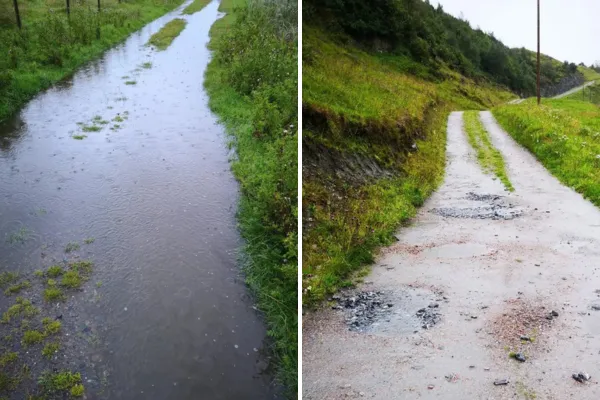
Adjacent crofts on the same day, same time, different management. LEFT: set stock grazed land. RIGHT: holistically-managed land.
A Rainy Morning in Scotland
Farmers often ask, 'will Holistic Management work on my soggy farm?' Yes, absolutely! Let's use two adjacent farms in damp Western Scotland to illustrate.
It's all about learning how to manage for an effective water cycle, which means that all rain infiltrates the land instead of running off, carrying valuable soil with it.
The farm in the left-hand photos above and below is set stock grazed, which means low stock density and long grazing periods where livestock self-manage when to re-graze plants. This form of management typically results in both under-grazing and overgrazing of plants.
The farm in the right-hand photos above and below shares a fence-line with the set-stock grazed farm, and uses holistic planned grazing to manage the grazing.
It was pelting it down with rain on the morning these photos were taken. Rainfall on the holistically-managed farm during the 29th-31st of August 2019 was 84 mm (3.3 inches). These photos were taken on the morning of the 31st. Average annual rainfall for the area over the past 16 years was 1792 mm (70.6 inches), with 151 mm (5.9 inches) in August on average.
On the set-stock grazed farm roads were flooded, water stood in puddles on the grass, and multiple torrents and cascades of water shot across the land. By contrast, the holistically-planned grazed farm had dry roads, no grass puddles, and there were no torrents in the places where there used to be as little as one year ago.
The holistically-managed farm changed its management from set-stock grazing only three years ago.

Left: puddles appeared everywhere in the short grass on the set-stock grazed farm. Right: grass on the holistically-managed farm fully absorbed the heavy rainfall.
One Gram of Soil Organic Carbon Holds Eight Grams of Water
Soil organic carbon turns soil into a 'sponge' that absorbs water effectively. One gram of soil organic carbon holds eight grams of water. An effective water cycle minimises the negative impacts of drought and flood. In order to manage for an effective water cycle, we need to find ways to increase soil organic carbon.
Set stock grazing leads to grass that has difficulty absorbing water. Overgrazing leads to bare soil, and when it rains that soil gets capped, which means water and air cannot easily infiltrate the soil. Overgrazing combined with an ineffective water cycle results in stunted plants that feed the soil microbiome poorly. The poor conversion of solar energy into plant material robs the soil of the development of sponge. This is known as an ineffective water cycle.
By contrast, holistic planned grazing leads to grass that is able to swallow up water quickly, storing it deep in the soil until it is needed by plants during a dry spell. Overgrazing is eliminated, which enables plants to provide a dense canopy over bare soil, protecting it from capping by rain. The impact of animal hooves breaks up capped soil, opening up the soil for good water infiltration and aeration. High animal impact is counter-balanced with long periods of rest to allow plants time for full recovery. Tall plants with deep roots feed life under the soil contributing to development of 'sponge'. The microbes, insects and roots create pathways for air and water to penetrate soil. Deep-rooted plants are able to draw up deep water stores when needed. This is known as an effective water cycle.

Left: a torrent on the set-stocked croft. Right: a dry ditch on the holistically-managed croft.
What Are Some Tips for Improving Your Water Cycle?
Increase plant density to cover bare soil all year long.
Increase plant diversity to encourage different root structures and depths.
Encourage the growth of shrubs and trees to help absorb heavy rains.
Uncap soil by grazing with high stock density interspersed with intervals of rest that are long enough to allow plants to fully recover.

Willows leave dry path during heavy downpour.
Learn How to Manage Holistically
There are plenty of opportunities to learn how to manage holistically: go on a public course, take an online course, or hire us to train you on your farm.

