Gross Profit Analysis — Which Enterprise Truly Pays?
Building Holistic Thinking Muscle
Week 4: Gross Profit Analysis
Not all income is equal.
By now you have checked:
Cause & Effect — Are we solving the right problem?
Weak Link — Are we strengthening the weakest part of the system?
Marginal Reaction — Are we choosing the option that provides the greatest return?
Now we shift focus.
Not between actions.
But between enterprises.
Gross Profit Analysis asks a simple question.
Which enterprises contribute the most to covering the overheads of the business?
It is easy to assume:
More production = more profit.
But this is often not the case.
Some enterprises look productive.
Some look impressive.
But when costs are accounted for, they may contribute very little — or even drain resources.
Turnover is not the same as profit.
Gross Profit Analysis looks beyond total income.
It asks:
What is left after the direct costs of that enterprise are paid?
This is gross profit: income minus direct costs.
This allows us to compare enterprises fairly.
A true story from North Carolina
In the 1960s, mountain dairymen in North Carolina were encouraged to modernise their operations.
Experts promoted continuous milking parlours, feedlots, and more intensive feeding systems. On paper, the numbers looked attractive. Profit per cow appeared stronger, and the traditional system of grazing cows on steep mountain pasture began to look outdated.
But the comparison was misleading.
The land still had to be paid for. Mortgages still had to be serviced. Taxes still had to be paid — and those taxes were rising as second-home development pushed up land values across the region.
At the same time, much of the mountain pasture went out of use. In that environment, unused grassland quickly reverted to forest. There was no easy way back.
Gross profit analysis would have asked:
Which way of managing dairy cows contributes most toward covering overhead costs?
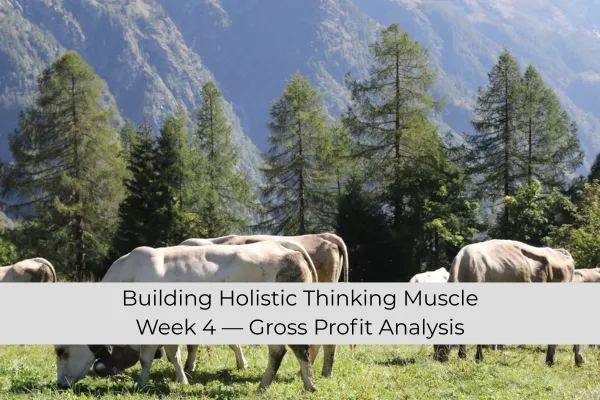
The mountain grazing system, though less modern, had relatively low direct costs and made full use of the land. Each cow contributed steadily toward covering overhead costs.
The more intensive system appeared productive, but it came with significantly higher direct costs — feed, infrastructure, and labour — while leaving much of the land underutilised.
In simple terms:
The system that looked more modern and efficient was not necessarily the one that best supported the business as a whole.
Over time, the consequences became clear. The dairy herds disappeared from these mountain farms, and many who remained viable did so by selling land for development.
Many businesses are busy but not profitable.
This pattern is common.
Enterprises grow because:
• They have always been there.
• They feel important.
• They generate visible income.
But without analysis, it is easy to miss:
Which ones are actually contributing.
Gross Profit Analysis brings clarity.
This question helps you compare enterprises.
Which ones require improvement?
Which ones may need to be let go entirely?
Next week
Next week we explore Energy / Money Source & Use.
Gross Profit Analysis shows which enterprises generate the most value.
Energy / Money Source & Use asks:
Where is that value coming from — and where is it going?

